Showing posts with label Cybernetics. Show all posts

SC - 1407 | Python Deep Learning: Exploring deep learning techniques, neural network architectures and GANs with PyTorch, Keras and TensorFlow

Exploring an advanced state of the art deep learning models and its applications using Popular python libraries like Keras, Tensorflow, and Pytorch

Key Features
• A strong foundation on neural networks and deep learning with Python libraries.
• Explore advanced deep learning techniques and their applications across computer vision and NLP.
• Learn how a computer can navigate in complex environments with reinforcement learning.

Book Description
With the surge of Artificial Intelligence in each and every application catering to both business and consumer needs, Deep Learning becomes the prime need of today and future market demands. This book explores deep learning and builds a strong deep learning mindset in order to put them into use in their smart artificial intelligence projects.
This second edition builds strong grounds of deep learning, deep neural networks and how to train them with high-performance algorithms and popular python frameworks. You will uncover different neural networks architectures like convolutional networks, recurrent networks, long short term memory (LSTM) and solve problems across image recognition, natural language processing, and time-series prediction. You will also explore the newly evolved area of reinforcement learning and it will help you to understand the state-of-the-art algorithms which are the main engines behind popular game Go, Atari, and Dota.
By the end of the book, you will be well versed with practical deep learning knowledge and its real-world applications

What you will learn
• Grasp mathematical theory behind neural networks and deep learning process.
• Investigate and resolve computer vision challenges using convolutional networks and capsule networks.
• Solve Generative tasks using Variational Autoencoders and Generative Adversarial Nets (GANs).
• Explore Reinforcement Learning and understand how agents behave in a complex environment.
• Implement complex natural language processing tasks using recurrent networks (LSTM, GRU), and attention models.

Who This Book Is For
This book is for Data Science practitioners, Machine Learning Engineers and Deep learning aspirants who have a basic foundation of Machine Learning concepts and some programming experience with Python. A mathematical background with a conceptual understanding of calculus and statistics is also desireD.


 By: Ivan Vasilev, Daniel Slater, Gianmario Spacagna, Peter Roelants, Valentino Zocca


ID:  SC - 1407


SC - 1333 | Applied Text Analysis with Python: Enabling Language-Aware Data Products with Machine Learning

Benjamin Bengfort, Tony Ojeda, Rebecca Bilbro

From news and speeches to informal chatter on social media, natural language is one of the richest and most underutilized sources of data. Not only does it come in a constant stream, always changing and adapting in context; it also contains information that is not conveyed by traditional data sources. The key to unlocking natural language is through the creative application of text analytics. This practical book presents a data scientist’s approach to building language-aware products with applied machine learning.

You’ll learn robust, repeatable, and scalable techniques for text analysis with Python, including contextual and linguistic feature engineering, vectorization, classification, topic modeling, entity resolution, graph analysis, and visual steering. By the end of the book, you’ll be equipped with practical methods to solve any number of complex real-world problems.

● Preprocess and vectorize text into high-dimensional feature representations
● Perform document classification and topic modeling
● Steer the model selection process with visual diagnostics
● Extract key phrases, named entities, and graph structures to reason about data in text
● Build a dialog framework to enable chatbots and language-driven interaction
● Use Spark to scale processing power and neural networks to scale model complexity

Categories: Computers\\Cybernetics: Artificial Intelligence
Year: 2018
Edition: 1
Publisher: O’Reilly Media
Language: english
Pages: 332
ISBN 10: 1491963042
ISBN 13: 9781491963043

ID:  SC - 1333


SC - 1332 | Python Data Analytics: With Pandas, NumPy, and Matplotlib

Fabio Nelli

Explore the latest Python tools and techniques to help you tackle the world of data acquisition and analysis. You'll review scientific computing with NumPy, visualization with matplotlib, and machine learning with scikit-learn.

This revision is fully updated with new content on social media data analysis, image analysis with OpenCV, and deep learning libraries. Each chapter includes multiple examples demonstrating how to work with each library. At its heart lies the coverage of pandas, for high-performance, easy-to-use data structures and tools for data manipulation

Author Fabio Nelli expertly demonstrates using Python for data processing, management, and information retrieval. Later chapters apply what you've learned to handwriting recognition and extending graphical capabilities with the JavaScript D3 library. Whether you are dealing with sales data, investment data, medical data, web page usage, or other data sets, Python Data Analytics, Second Edition is an invaluable reference with its examples of storing, accessing, and analyzing data.

What You'll Learn
Understand the core concepts of data analysis and the Python ecosystem
Go in depth with pandas for reading, writing, and processing data
Use tools and techniques for data visualization and image analysis
Examine popular deep learning libraries Keras, Theano,TensorFlow, and PyTorch

Who This Book Is For
Experienced Python developers who need to learn about Pythonic tools for data analysis

Categories: Computers\\Cybernetics: Artificial Intelligence
Year: 2018
Edition: 2
Publisher: Apress
Language: english
Pages: 569 / 576
ISBN 10: 1484239121
ISBN 13: 978-1484239124

ID:  SC - 1332


SC - 1330 | Grokking Deep Learning

Andrew W. Trask

Artificial Intelligence is the most exciting technology of the century, and Deep Learning is, quite literally, the "brain" behind the world's smartest Artificial Intelligence systems out there.

Grokking Deep Learning is the perfect place to begin the deep learning journey. Rather than just learning the "black box" API of some library or framework, readers will actually understand how to build these algorithms completely from scratch.

Want to dig even deeper into Deep Learning? Be sure to check out our video course Grokking Deep Learning in Motion, available exclusively at Manning.com

Categories: Computers\\Cybernetics: Artificial Intelligence
Year: 2019
Edition: 1
Publisher: Manning Publications
Language: english
Pages: 325 / 335
ISBN 10: 1617293709
ISBN 13: 978-1617293702

ID:  SC - 1330


SC - 1329 | Practical Computer Vision Applications Using Deep Learning with CNNs: With Detailed Examples in Python Using TensorFlow and Kivy

Ahmed Fawzy Gad

Deploy deep learning applications into production across multiple platforms. You will work on computer vision applications that use the convolutional neural network (CNN) deep learning model and Python. This book starts by explaining the traditional machine-learning pipeline, where you will analyze an image dataset. Along the way you will cover artificial neural networks (ANNs), building one from scratch in Python, before optimizing it using genetic algorithms.

For automating the process, the book highlights the limitations of traditional hand-crafted features for computer vision and why the CNN deep-learning model is the state-of-art solution. CNNs are discussed from scratch to demonstrate how they are different and more efficient than the fully connected ANN (FCNN). You will implement a CNN in Python to give you a full understanding of the model.

After consolidating the basics, you will use TensorFlow to build a practical image-recognition model that you will deploy to a web server using Flask, making it accessible over the Internet. Using Kivy and NumPy, you will create cross-platform data science applications with low overheads.
This book will help you apply deep learning and computer vision concepts from scratch, step-by-step from conception to production.

What You Will Learn
• Understand how ANNs and CNNs work
• Create computer vision applications and CNNs from scratch using Python
• Follow a deep learning project from conception to production using TensorFlow
• Use NumPy with Kivy to build cross-platform data science applications

Who This Book Is For
Data scientists, machine learning and deep learning engineers, software developers.

Categories: Computers\\Cybernetics: Artificial Intelligence
Year: 2019
Edition: 1
Publisher: Apress
Language: english
Pages: 405 / 421
ISBN 10: 1484241665
ISBN 13: 978-1484241660

ID:  SC - 1329


SC - 1328 | Advanced Penetration Testing. Hacking the World’s Most Secure Networks

Wil Allsopp

Build a better defense against motivated, organized, professional attacks.

Advanced Penetration Testing: Hacking the World's Most Secure Networks takes hacking far beyond Kali Linux and Metasploit to provide a more complex attack simulation.
Featuring techniques not taught in any certification prep or covered by common defensive scanners, this book integrates social engineering, programming, and vulnerability exploits into a multidisciplinary approach for targeting and compromising high security environments.

From discovering and creating attack vectors, and moving unseen through a target enterprise, to establishing command and exfiltrating data—even from organizations without a direct Internet connection—this guide contains the crucial techniques that provide a more accurate picture of your system's defense. Custom coding examples use VBA, Windows Scripting Host, C, Java, JavaScript, Flash, and more, with coverage of standard library applications and the use of scanning tools to bypass common defensive measures.

Typical penetration testing consists of low-level hackers attacking a system with a list of known vulnerabilities, and defenders preventing those hacks using an equally well-known list of defensive scans. The professional hackers and nation states on the forefront of today's threats operate at a much more complex level—and this book shows you how to defend your high security network.

Use targeted social engineering pretexts to create the initial compromise
Leave a command and control structure in place for long-term access
Escalate privilege and breach networks, operating systems, and trust structures
Infiltrate further using harvested credentials while expanding control

Today's threats are organized, professionally-run, and very much for-profit. Financial institutions, health care organizations, law enforcement, government agencies, and other high-value targets need to harden their IT infrastructure and human capital against targeted advanced attacks from motivated professionals. Advanced Penetration Testing goes beyond Kali linux and Metasploit and to provide you advanced pen testing for high security networks.

Categories: Computers\\Cybernetics
Year: 2017
Edition: 1
Publisher: Wiley
Language: english
Pages: 288
ISBN 10: 1119367689

ID:  SC - 1328


SC - 1327 | Machine Learning Applications Using Python: Cases Studies from Healthcare, Retail, and Finance

Puneet Mathur

Gain practical skills in machine learning for finance, healthcare, and retail. This book uses a hands-on approach by providing case studies from each of these domains: you’ll see examples that demonstrate how to use machine learning as a tool for business enhancement. As a domain expert, you will not only discover how machine learning is used in finance, healthcare, and retail, but also work through practical case studies where machine learning has been implemented.

Machine Learning Applications Using Python is divided into three sections, one for each of the domains (healthcare, finance, and retail). Each section starts with an overview of machine learning and key technological advancements in that domain. You’ll then learn more by using case studies on how organizations are changing the game in their chosen markets. This book has practical case studies with Python code and domain-specific innovative ideas for monetizing machine learning.

What You Will Learn
• Discover applied machine learning processes and principles
• Implement machine learning in areas of healthcare, finance, and retail
• Avoid the pitfalls of implementing applied machine learning
• Build Python machine learning examples in the three subject areas

Who This Book Is For
Data scientists and machine learning professionals.

Categories: Computers\\Cybernetics: Artificial Intelligence
Year: 2019
Edition: 1
Publisher: Apress
Language: english
Pages: 379 / 384
ISBN 10: 1484237862
ISBN 13: 978-1484237861

ID:  SC - 1327


SC - 1326 | Artificial Intelligence: With an Introduction to Machine Learning

Richard E. Neapolitan, Xia Jiang

The first edition of this popular textbook, Contemporary Artificial Intelligence, provided an accessible and student friendly introduction to AI. This fully revised and expanded update, Artificial Intelligence: With an Introduction to Machine Learning, Second Edition, retains the same accessibility and problem-solving approach, while providing new material and methods.

The book is divided into five sections that focus on the most useful techniques that have emerged from AI. The first section of the book covers logic-based methods, while the second section focuses on probability-based methods. Emergent intelligence is featured in the third section and explores evolutionary computation and methods based on swarm intelligence. The newest section comes next and provides a detailed overview of neural networks and deep learning. The final section of the book focuses on natural language understanding.

Suitable for undergraduate and beginning graduate students, this class-tested textbook provides students and other readers with key AI methods and algorithms for solving challenging problems involving systems that behave intelligently in specialized domains such as medical and software diagnostics, financial decision making, speech and text recognition, genetic analysis, and more.

Categories: Computers\\Cybernetics: Artificial Intelligence
Year: 2018
Edition: 2
Publisher: Chapman and Hall/CRC
Language: english
Pages: 480 / 457
ISBN 10: 1138502383
ISBN 13: 9781138502383
Series: Chapman & Hall/CRC Artificial Intelligence and Robotics Series

ID:  SC - 1326


SC - 1325 | Playing Smart: On Games, Intelligence, and Artificial Intelligence

Julian Togelius

A new vision of the future of games and game design, enabled by AI.Can games measure intelligence? How will artificial intelligence inform games of the future? In Playing Smart, Julian Togelius explores the connections between games and intelligence to offer a new vision of future games and game design. Video games already depend on AI. We use games to test AI algorithms, challenge our thinking, and better understand both natural and artificial intelligence. In the future, Togelius argues, game designers will be able to create smarter games that make us smarter in turn, applying advanced AI to help design games. In this book, he tells us how.

Games are the past, present, and future of artificial intelligence. In 1948, Alan Turing, one of the founding fathers of computer science and artificial intelligence, handwrote a program for chess. Today we have IBM's Deep Blue and DeepMind's AlphaGo, and huge efforts go into developing AI that can play such arcade games as Pac-Man. Programmers continue to use games to test and develop AI, creating new benchmarks for AI while also challenging human assumptions and cognitive abilities.

Game design is at heart a cognitive science, Togelius reminds us―when we play or design a game, we plan, think spatially, make predictions, move, and assess ourselves and our performance. By studying how we play and design games, Togelius writes, we can better understand how humans and machines think. AI can do more for game design than providing a skillful opponent. We can harness it to build game-playing and game-designing AI agents, enabling a new generation of AI-augmented games. With AI, we can explore new frontiers in learning and play.

Categories: Computers\\Cybernetics: Artificial Intelligence
Year: 2019
Edition: 1
Publisher: The MIT Press
Language: english
Pages: 192 / 188
ISBN 10: 0262039036
ISBN 13: 978-0262039031
Series: Playful Thinking

ID:  SC - 1325


SC - 1323 | Neural Networks A Visual Introduction for Beginners by Michael Taylor

Michael Taylor

A step-by-step visual journey through the mathematics of neural networks, and making your own using Python and Tensorflow.

Categories: Computers\\Cybernetics: Artificial Intelligence
Year: 2017
Edition: Paperback
Publisher: Blue Windmill Media
Language: english
Pages: 250
ISBN 10: 1549869132
ISBN 13: 9781549869136

ID:  SC - 1323


SC - 1322 | Thoughtful Machine Learning with Python: A Test-Driven Approach

Matthew Kirk

Gain the confidence you need to apply machine learning in your daily work. With this practical guide, author Matthew Kirk shows you how to integrate and test machine learning algorithms in your code, without the academic subtext.

Featuring graphs and highlighted code examples throughout, the book features tests with Python’s Numpy, Pandas, Scikit-Learn, and SciPy data science libraries. If you’re a software engineer or business analyst interested in data science, this book will help you:

    Reference real-world examples to test each algorithm through engaging, hands-on exercises
    Apply test-driven development (TDD) to write and run tests before you start coding
    Explore techniques for improving your machine-learning models with data extraction and feature development
    Watch out for the risks of machine learning, such as underfitting or overfitting data
    Work with K-Nearest Neighbors, neural networks, clustering, and other algorithms

Categories: Computers\\Cybernetics
Year: 2017
Edition: 1
Publisher: O’Reilly Media
Language: english
Pages: 216
ISBN 10: 1491924136
ISBN 13: 9781491924136

ID:  SC - 1322


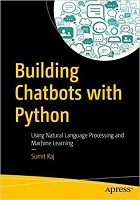
SC - 1321 | Building Chatbots with Python: Using Natural Language Processing and Machine Learning

Sumit Raj

Build your own chatbot using Python and open source tools. This book begins with an introduction to chatbots where you will gain vital information on their architecture. You will then dive straight into natural language processing with the natural language toolkit (NLTK) for building a custom language processing platform for your chatbot. With this foundation, you will take a look at different natural language processing techniques so that you can choose the right one for you.

The next stage is to learn to build a chatbot using the API.ai platform and define its intents and entities. During this example, you will learn to enable communication with your bot and also take a look at key points of its integration and deployment.

The final chapter of Building Chatbots with Python teaches you how to build, train, and deploy your very own chatbot. Using open source libraries and machine learning techniques you will learn to predict conditions for your bot and develop a conversational agent as a web application. Finally you will deploy your chatbot on your own server with AWS.

What You Will Learn
• Gain the basics of natural language processing using Python
• Collect data and train your data for the chatbot
• Build your chatbot from scratch as a web app
• Integrate your chatbots with Facebook, Slack, and Telegram
• Deploy chatbots on your own server

Who This Book Is For
Intermediate Python developers who have no idea about chatbots. Developers with basic Python programming knowledge can also take advantage of the book.

Categories: Computers\\Cybernetics: Artificial Intelligence
Year: 2019
Edition: 1
Publisher: Apress
Language: english
Pages: 192 / 205
ISBN 10: 1484240952
ISBN 13: 978-1484240953

ID:  SC - 1321


SC - 1320 | Machine Learning with Python Cookbook: Practical Solutions from Preprocessing to Deep Learning

Chris Albon

This practical guide provides nearly 200 self-contained recipes to help you solve machine learning challenges you may encounter in your daily work. If you’re comfortable with Python and its libraries, including pandas and scikit-learn, you’ll be able to address specific problems such as loading data, handling text or numerical data, model selection, and dimensionality reduction and many other topics.

Each recipe includes code that you can copy and paste into a toy dataset to ensure that it actually works. From there, you can insert, combine, or adapt the code to help construct your application. Recipes also include a discussion that explains the solution and provides meaningful context. This cookbook takes you beyond theory and concepts by providing the nuts and bolts you need to construct working machine learning applications.

You’ll find recipes for:
● Vectors, matrices, and arrays
● Handling numerical and categorical data, text, images, and dates and times
● Dimensionality reduction using feature extraction or feature selection
● Model evaluation and selection
● Linear and logical regression, trees and forests, and k-nearest neighbors
● Support vector machines (SVM), naïve Bayes, clustering, and neural networks
● Saving and loading trained models

Who This Book Is For
This book is not an introduction to machine learning. If you are not comfortable with the basic concepts of machine learning or have never spent time learning machine learning, do not buy this book. Instead, this book is for the machine learning practitioner who, while comfortable with the theory and concepts of machine learning, would benefit from a quick reference containing code to solve challenges he runs into working on machine learning on an everyday basis.
This book assumes the reader is comfortable with the Python programming language and package management.

Who This Book Is Not For
As stated previously, this book is not an introduction to machine learning. This book should not be your first. If you are unfamiliar with concepts like cross-validation, random forest, and gradient descent, you will likely not benefit from this book as much as one of the many high-quality texts specifically designed to introduce you to the topic. I recommend reading one of those books and then coming back to this book to learn working, practical solutions for machine learning.

Categories: Computers\\Cybernetics: Artificial Intelligence
Year: 2018
Edition: 1
Publisher: O’Reilly Media
Language: english
Pages: 366
ISBN 10: 1491989386
ISBN 13: 9781491989388

ID:  SC - 1320


SC - 1312 | Natural Language Processing Recipes: Unlocking Text Data with Machine Learning and Deep Learning using Python

Akshay Kulkarni, Adarsha Shivananda

Implement natural language processing applications with Python using a problem-solution approach. This book has numerous coding exercises that will help you to quickly deploy natural language processing techniques, such as text classification, parts of speech identification, topic modeling, text summarization, text generation, entity extraction, and sentiment analysis.

Natural Language Processing Recipes starts by offering solutions for cleaning and preprocessing text data and ways to analyze it with advanced algorithms. You’ll see practical applications of the semantic as well as syntactic analysis of text, as well as complex natural language processing approaches that involve text normalization, advanced preprocessing, POS tagging, and sentiment analysis. You will also learn various applications of machine learning and deep learning in natural language processing.

By using the recipes in this book, you will have a toolbox of solutions to apply to your own projects in the real world, making your development time quicker and more efficient.

What You Will Learn

• Apply NLP techniques using Python libraries such as NLTK, TextBlob, spaCy, Stanford CoreNLP, and many more
• Implement the concepts of information retrieval, text summarization, sentiment analysis, and other advanced natural language processing techniques.
• Identify machine learning and deep learning techniques for natural language processing and natural language generation problems

Who This Book Is For

Data scientists who want to refresh and learn various concepts of natural language processing through coding exercises.

Categories: Computers\\Cybernetics: Artificial Intelligence
Year: 2019
Edition: 1
Publisher: Apress
Language: english
Pages: 234 / 253
ISBN 10: 1484242661
ISBN 13: 978-1484242667

ID:  SC - 1312


SC - 1311 | The Beauty of Mathematics in Computer Science

Jun Wu

The Beauty of Mathematics in Computer Science explains the mathematical fundamentals of information technology products and services we use every day, from Google Web Search to GPS Navigation, and from speech recognition to CDMA mobile services.
The book was published in Chinese in 2011 and has sold more than 600,000 copies.

Readers were surprised to find that many daily-used IT technologies were so tightly tied to mathematical principles. For example, the automatic classification of news articles uses the cosine law taught in high school.

The book covers many topics related to computer applications and applied mathematics including:
• Natural language processing
• Speech recognition and machine translation
• Statistical language modeling
• Quantitive measurement of information
• Graph theory and web crawler
• Pagerank for web search
• Matrix operation and document classification
• Mathematical background of big data
• Neural networks and Google’s deep learning

Jun Wu was a staff research scientist in Google who invented Google’s Chinese, Japanese, and Korean Web Search Algorithms and was responsible for many Google machine learning projects. He wrote official blogs introducing Google technologies behind its products in very simple languages for Chinese Internet users from 2006-2010.

The blogs had more than 2 million followers. Wu received PhD in computer science from Johns Hopkins University and has been working on speech recognition and natural language processing for more than 20 years. He was one of the earliest engineers of Google, managed many products of the company, and was awarded 19 US patents during his 10-year tenure there. Wu became a full-time VC investor and co-founded Amino Capital in Palo Alto in 2014 and is the author of eight books.

Categories: Computers\\Cybernetics
Year: 2018
Edition: 1
Publisher: CRC Press
Language: english
Pages: 284 / 285
ISBN 10: 1138049603
ISBN 13: 978-1138049604

ID:  SC - 1311


SC - 1309 | Beyond Artificial Intelligence: From Human Consciousness to Artificial Consciousness

Alain Cardon

This book will present a complete modeling of the human psychic system that allows to generate the thoughts in a strictly organizational approach that mixes a rising and falling approach. The model will present the architecture of the psychic system that can generate sensations and thoughts, showing how one can feel thoughts.

The model developed into an organizational architecture based on massive multiagent systems. The architecture will be fully developed, showing how an artificial system can be endowed with consciousness and intentionally generate thoughts and, especially, feel them. These results are multidisciplinary, combining both psychology and computer science disciplines.

Categories: Computers\\Cybernetics: Artificial Intelligence
Year: 2018
Edition: Hardcover
Publisher: Wiley-ISTE
Language: english
Pages: 232 / 227
ISBN 10: 1786303590
ISBN 13: 9781786303592
Series: Computer Engineering

ID:  SC - 1309


SC - 1307 | Learn Keras for Deep Neural Networks: A Fast-Track Approach to Modern Deep Learning with Python

Jojo John Moolayil

Learn, understand, and implement deep neural networks in a math- and programming-friendly approach using Keras and Python. The book focuses on an end-to-end approach to developing supervised learning algorithms in regression and classification with practical business-centric use-cases implemented in Keras.

The overall book comprises three sections with two chapters in each section. The first section prepares you with all the necessary basics to get started in deep learning. Chapter 1 introduces you to the world of deep learning and its difference from machine learning, the choices of frameworks for deep learning, and the Keras ecosystem. You will cover a real-life business problem that can be solved by supervised learning algorithms with deep neural networks. You’ll tackle one use case for regression and another for classification leveraging popular Kaggle datasets.

Later, you will see an interesting and challenging part of deep learning: hyperparameter tuning; helping you further improve your models when building robust deep learning applications. Finally, you’ll further hone your skills in deep learning and cover areas of active development and research in deep learning.

At the end of Learn Keras for Deep Neural Networks, you will have a thorough understanding of deep learning principles and have practical hands-on experience in developing enterprise-grade deep learning solutions in Keras.

What You’ll Learn

• Master fast-paced practical deep learning concepts with math- and programming-friendly abstractions.
• Design, develop, train, validate, and deploy deep neural networks using the Keras framework
• Use best practices for debugging and validating deep learning models
• Deploy and integrate deep learning as a service into a larger software service or product
• Extend deep learning principles into other popular frameworks

Who This Book Is For

Software engineers and data engineers with basic programming skills in any language and who are keen on exploring deep learning for a career move or an enterprise project.

Categories: Computers\\Cybernetics: Artificial Intelligence
Year: 2019
Edition: 1
Publisher: Apress
Language: english
Pages: 182 / 192
ISBN 10: 1484242394
ISBN 13: 978-1484242391

ID:  SC - 1307


SC - 1331 | Machine Learning For Dummies

John Paul Mueller, Luca Massaron

Machine learning can be a mind-boggling concept for the masses, but those who are in the trenches of computer programming know just how invaluable it is. Without machine learning, fraud detection, web search results, real-time ads on web pages, credit scoring, automation, and email spam filtering wouldnt be possible, and this is only showcasing just a few of its capabilities. Written by two data science experts, Machine Learning For Dummies offers a much-needed entry point for anyone looking to use machine learning to accomplish practical tasks.

Covering the entry-level topics needed to get you familiar with the basic concepts of machine learning, this guide quickly helps you make sense of the programming languages and tools you need to turn machine learning-based tasks into a reality. Whether youre maddened by the math behind machine learning, apprehensive about AI, perplexed by preprocessing data—or anything in between—this guide makes it easier to understand and implement machine learning seamlessly.

Categories: Computers\\Cybernetics: Artificial Intelligence
Year: 2016
Edition: 1
Publisher: For Dummies
Language: english
Pages: 432 / 435
ISBN 10: 1119245516
ISBN 13: 9781119245513
Series: Computer/Tech

ID:  SC - 1331


SC - 1314 | Foundations of Quantum Programming

Mingsheng Ying

Foundations of Quantum Programming discusses how new programming methodologies and technologies developed for current computers can be extended to exploit the unique power of quantum computers, which promise dramatic advantages in processing speed over currently available computer systems.

Governments and industries around the globe are now investing vast amounts of money with the expectation of building practical quantum computers. Drawing upon years of experience and research in quantum computing research and using numerous examples and illustrations, Mingsheng Ying has created a very useful reference on quantum programming languages and important tools and techniques required for quantum programming, making the book a valuable resource for academics, researchers, and developers.

• Demystifies the theory of quantum programming using a step-by-step approach
• Covers the interdisciplinary nature of quantum programming by providing examples from many different fields including, engineering, computer science, medicine, and life sciences
• Includes techniques and tools to solve complex control flow patterns and synchronize computations
• Presents a coherent and self-contained treatment that will be valuable for academics and industrial researchers and developers

Categories: Computers\\Cybernetics
Year: 2016
Edition: 1
Publisher: Morgan Kaufmann Publishers
Language: english
Pages: 372 / 356
ISBN 10: 0128023066
ISBN 13: 9780128023068

ID:  SC - 1314


SC - 1310 | Cybernetics: From Past to Future

D.A. Novikov

This book is a concise navigator across the history of cybernetics, its state-of-the-art and prospects. The evolution of cybernetics (from N. Wiener to the present day) and the reasons of its ups and downs are presented. The correlation of cybernetics with the philosophy and methodology of control, as well as with system theory and systems analysis is clearly demonstrated.

The book presents a detailed analysis focusing on the modern trends of research in cybernetics. A new development stage of cybernetics (the so-called cybernetics 2.0) is discussed as a science on general regularities of systems organization and control. The author substantiates the topicality of elaborating a new branch of cybernetics, i.e. organization theory which studies an organization as a property, process and system.

The book is intended for theoreticians and practitioners, as well as for students, postgraduates and doctoral candidates. In the first place, the target audience includes tutors and lecturers preparing courses on cybernetics, control theory and systems science.

Categories: Computers\\Cybernetics
Year: 2016
Publisher: Springer
Language: english
Pages: 115
ISBN 10: 3319273965
ISBN 13: 9783319273969
Series: Studies in Systems, Decision and Control 47

ID:  SC - 1310


Napomene:
- clanovima nase biblioteke omogucen je pristup resursima Svetske elektronske biblioteke (World electronic library - WELIB), na linku WELIBRS, gde se mogu pronaci knjige na srpskom jeziku. Napominjemo da mi samo ostvarujemo saradnju sa ovom bibliotekom, a nismo njen deo.

- u jednom postu se nalazi onoliko knjiga od istog autora koliko smo ih dobili u tom trenutku - ako zelite da vidite kompletan spisak svih postavljenih knjiga istog autora na celom blogu - mozete ih pronaci putem stranice sa spiskom autora ili putem taga sa imenom autora ispod naslova odgovarajuceg posta.